How often should I change litter shared by two cats?
The answer, first: for two cats, scoop at least once a day, twice if they share one box, and fully change clumping litter about every 1 to 3 weeks. If the two cats use one box, expect the short end of that range. If they have three clean boxes between them, the litter can often last closer to the normal one-cat schedule.
Count box use, not just cats
A household total can hide one overloaded tray. The 2024 Cat Friendly Practice Guide from the American Association of Feline Practitioners gives a general rule of one box per cat plus one extra, in different locations, and says boxes should be scooped once or twice daily. It does not give one fixed full-change interval for every two-cat household.
The ASPCA general-care guidance says to scoop at least daily and to dump, wash, and refill at least weekly, with less frequent full changes possible for clumping litter. Those are general care directions, not a measured schedule for every material and box-sharing pattern.
Published schedules differ by material and source
| Source | What it says | Limit of that guidance |
|---|---|---|
| Arm & Hammer | For clumping litter, it describes a 2–3 week full change for more than one cat; for non-clumping litter, it gives every other day for more than one cat. | Its article also says there is no hard-and-fast rule and that output and cat habits matter; these are the publisher's recommendations. |
| BISSELL | For two or more cats, it says to scoop twice daily and change non-clumping litter every 4–5 days. | This is a product-company guide; it does not document a controlled comparison across two-cat homes. |
The sources agree that litter type and regular scooping matter, but they do not give the same non-clumping interval. Keep the material and box use beside the date instead of treating either schedule as a universal result.
Five dated two-cat records show why the calendar varies
Each row below is one household account. A reported routine is not a recommendation, and a missing result stays missing.
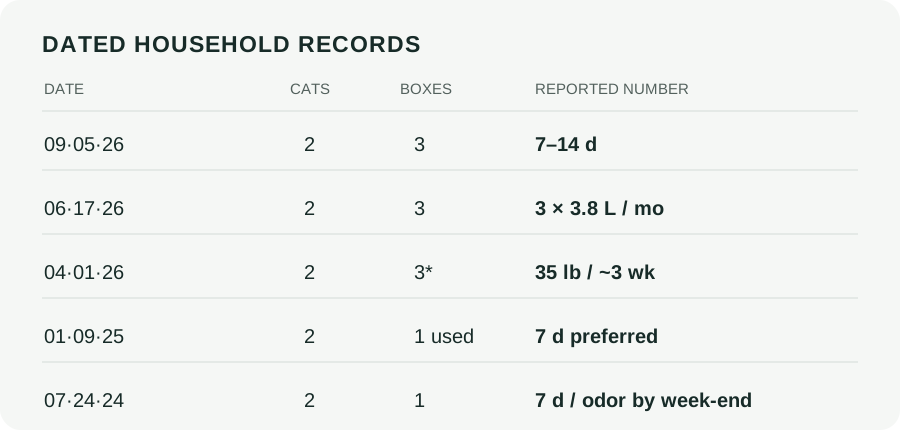
| Date | Household and setup | Routine or interval reported | Reported result | What this record cannot establish |
|---|---|---|---|---|
| 2026-09-05 | Two cats; three large boxes; changed from clumping litter to a bag, absorbent pad, and non-clumping clay. | Removed stool daily; replaced the full setup weekly or every 1–2 weeks. | The household reported lower cost and dust while pouring. | This is one household's combined setup; it does not isolate which component caused the cost or dust difference. |
| 2026-06-17 | Two cats; three hooded trays; silica crystal litter. | Removed stool daily, scrubbed trays monthly, and reported using three 3.8 L bags in a month. | The account gives a monthly amount used. | It does not state a full-change interval, and its bag amount is specific to that setup. |
| 2026-04-01 | Two cats initially used three smaller boxes unevenly; the household later moved to two XXL stainless-steel boxes that both cats used. | Daily scooping and top-offs; 35 lb lasted about three weeks before the box change. | Both cats used the two larger boxes. | The three-week amount was from the earlier arrangement; no post-change full-change interval was recorded. |
| 2025-01-09 | Two newly adopted street cats; three boxes were offered, but the cats shared one; the caregiver settled on clumping clay after trying other materials. | Scooped daily, or twice when both cats used the shared box; preferred a weekly full clean because of litter cost. | The caregiver described a weekly routine. | A possible monthly change was an estimate, not a completed monthly observation. |
| 2024-07-24 | Two cats; one shared box; non-clumping clay. | Removed stool and mixed the litter after urination; changed the box weekly. | The caregiver reported urine smell by the end of the week. | This is one box, one material, and one household; it does not set a schedule for other homes. |
Watch two of the dated household routines
The short summarizes two individual reports. Their different boxes, litter, and recorded routines are not a universal replacement schedule.
Make a per-box log before changing the routine
Use one row per box, not one row for the whole home. Record the date, which cats used that box, the litter material, scooping and top-off dates, the full-change date, and what you noticed at the change. That separates a heavily used box from a lightly used one and keeps a material switch from being mistaken for a cat-count effect.
Download the blank per-box litter-change log (CSV)
If you change the box count, litter, or how often you scoop, start a new dated run. Compare only rows with the setup written down; these household records do not show that one interval works for every two-cat home.
Where the evidence stops
The official guidance supplies general box and cleaning routines; the dated records show what five households reported under specific setups. Together they support recording use per box and adjusting from observed results. They do not establish a single safe or ideal full-change interval for all two-cat homes.