Dog Proof Litter Box: Keep the Dog Out and the Cat's Route Open
Start with a secured room gate or cat-only doorway, keeping the familiar litter box accessible while checking whether the dog can still reach it. Change the box itself only if the cat keeps using the replacement. A lid is not dog proof merely because it looks enclosed.
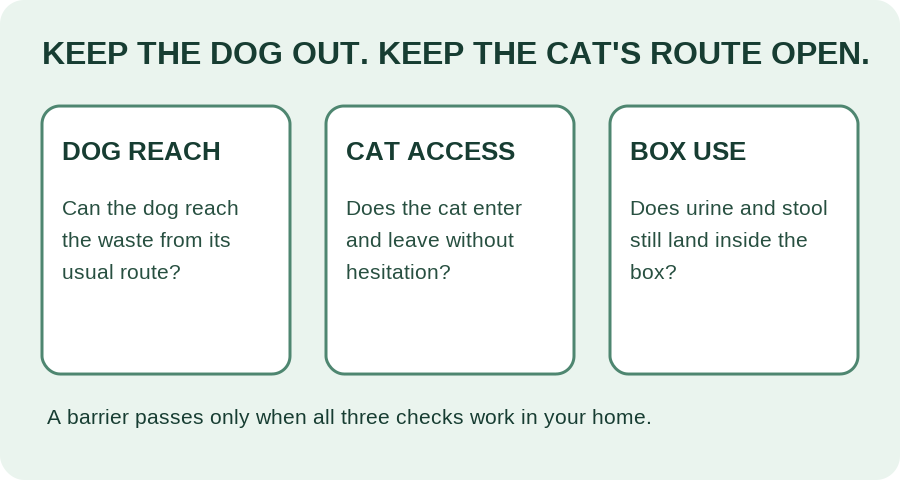
Check the route before buying a box
Watch how the dog reaches the waste now: through an open doorway, over a gate, around furniture, or through the litter-box opening. Then watch the cat's ordinary entry, toilet visit, and exit. Keep the accepted box available while you compare one change at a time. A barrier that stops the dog but also makes the cat avoid the toilet fails this test.
Cornell Feline Health Center advises that litter boxes be accessible at all times and notes that box, litter, and location can each affect use. It also notes lower-sided access needs for kittens, older cats, and cats with mobility problems. That makes a jump-only route a conditional choice, not a universal fix.
Pick the barrier that matches the actual failure
| Dog's route | Change to try | Cat-side check | Limit |
|---|---|---|---|
| Dog enters the room | Separate the room with a secured gate or door arrangement, leaving the familiar pan inside. | Watch the cat cross the barrier both ways and use the pan. | A small dog may pass the cat opening; an older cat may no longer jump a gate. |
| Dog reaches into a covered pan | Compare opening placement or a cabinet route before replacing the entire toilet. | Observe entry, turning, elimination, and exit. | A cover or narrow hole alone does not prove the dog cannot reach waste. |
| Dog reaches an open pan but cannot cross a higher entrance | Trial a top-entry or higher-sided design while the old pan stays available. | Check that urine and stool still land inside, not on the lid or floor. | Jumping ability and acceptance vary; do not infer success from a single entry. |
Eight dated households show why the two animals must be checked separately
These are individual reports, not controlled product trials. The dates identify the public posts or comments, not the start of each household's problem.
| Source and setup | What happened | What the report cannot prove |
|---|---|---|
| September 13, 2024: a bathroom held the cat's box; a commenter used a baby gate at a bathroom doorway. | The commenter reported that the gate kept the dog out of the litter-box and feeding space while the cats used the room. | This is a different household from the original question. It does not show that every cat can cross a gate or that every dog stays behind one. |
| October 31, 2025: one commenter had a cat-sized miniature dachshund and tried a top-opening box, then removed its lid because one cat was tall. | The commenter said the dog could not jump into the open-top container while the cats continued using it over years. | No measured reach or independent observation was supplied; it does not predict another small dog's jump. |
| October 31, 2025: another commenter used a covered or automatic box with an opening that admitted the cat but not a small dog. | The commenter described that opening as working in their home. | No opening measurements or repeated-use record were supplied; similar-sized animals may defeat this separation. |
| February 3, 2026: an owner tried a cover, a gate to jump, and a raised gate to crawl beneath. | The cat rejected the cover, would not jump the gate, and would crawl only through an opening the dog could also use. | No later working barrier was reported; this is a failed sequence in one home, not proof that gates never work. |
| May 17, 2026: a commenter adjusted a gate's cat opening for a 15-pound dog and cat. | The commenter said the cat fit through the opening while that dog could not. | The owner supplied no opening dimensions or longer follow-up; the dog’s weight alone cannot set a universal opening size. |
| June 25, 2026: a renter with a cat and same-sized dog tried a gate and a top-loading box. | The dog still fit through the gate, while the cat would not jump it, so the pet opening had to stay open. | The post offered no completed new solution and did not verify whether the dog could enter the top-loading box. |
| October 25, 2026: a dog slipped past a gate at night; the household tried a top-entry box. | The owner reported that the cat disliked the new box and urinated on its lid. | The post does not establish why the cat changed behavior or whether a later room barrier solved it. |
| November 13, 2026: a cat had previously crossed a gate to its box, then became unable to jump it with age. | The owner reported that a shorter gate, a raised gate, and a door prop each let the small dog or toddler defeat the separation. | The post had no completed replacement solution; it shows a change in access needs, not a tested new product. |
Inference from the eight reports: a barrier can succeed for one pair and fail when the dog's size, the cat's mobility, or the household route changes. The successful gate reports and the February, June, and November failures point in opposite directions on cat-only access; the two 2025 small-dog reports show different opening strategies, while the October top-entry failure separates dog exclusion from cat acceptance. Check both animals and the location of waste rather than labeling a box dog proof from its shape alone.
Run a small home check without claiming a product test
- Write down how the dog currently reaches the litter and whether the cat is using the accepted pan.
- Keep that pan accessible; change one route condition such as the room barrier or entrance orientation.
- Observe a complete cat visit and separately record whether the dog still reached waste. Mark unseen visits unknown.
- If the cat hesitates, eliminates outside, or loses access, restore the accepted route and reassess. A new or persistent toilet change deserves a veterinary call; Cornell notes medical as well as box-related causes of house-soiling.
Download the blank dog-and-cat route record (CSV). It records observed results; it is not a Cat Parent Lab product test.
Questions about keeping dogs out
How do I choose a litter box to keep dogs out?
Choose by the dog's actual reach and the cat's complete use, not by a “dog proof” label. The cases above include a gate that worked, a small opening that worked for one household, and a top-entry change the cat rejected.
Can I use my current cat litter box to keep dogs out?
Sometimes a room barrier leaves the familiar pan intact. The key check is whether that particular dog stays out and that particular cat can still reach the box; the older-cat account shows why yesterday's gate can become the wrong route.
Is there a litter box that dogs can't get into?
No design is proven to exclude every dog while serving every cat. Watch the dog's reach, then keep an accepted toilet available; no universal opening dimension was verified in the household reports.
For cat-only comparisons of a hood and a lid entrance, see our covered litter box and top-entry litter box guides. Those pages answer whether the cat can use each form; this page tests the dog and cat routes together.
Evidence boundary: The household records document reported setups and outcomes, not measured dog reach, controlled comparisons, or a guaranteed purchase. Cornell supports keeping the toilet accessible and assessing new house-soiling; it does not endorse a particular dog-proof product. Cat Parent Lab has not personally tested the products discussed here.