Cat Sitting in the Litter Box? Check Output Before Changing the Setup
If your cat sits in the litter box, check urine output first: repeated attempts with little or none need emergency veterinary care. A cat that has passed urine but newly keeps resting there still deserves a veterinary call; seeing one clump does not explain the sitting.
If you see repeated straining, frequent attempts, or little to no urine, seek urgent veterinary help instead of changing litter or waiting for a behavior trial. The International Cat Care guide calls urethral obstruction life-threatening and describes frequent visits with little or no urine among its signs.
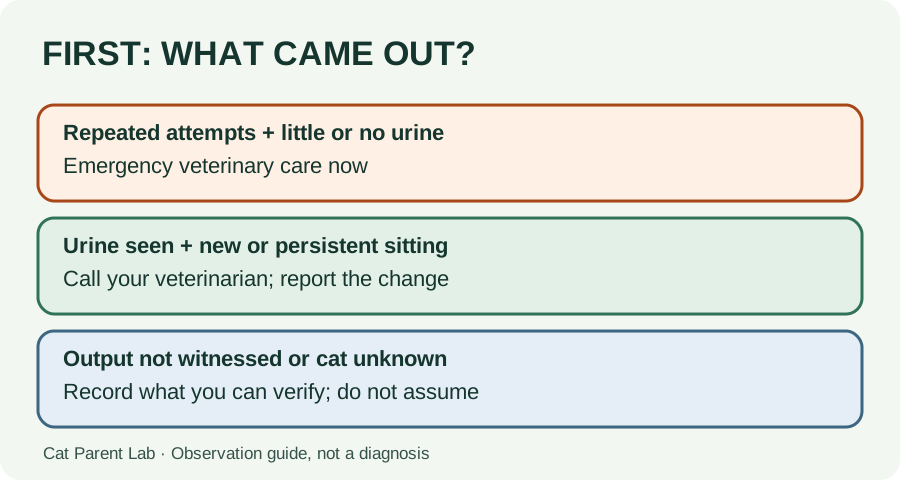
What did you actually see?
| Observation | Next action | What it cannot prove |
|---|---|---|
| Repeated attempts or straining with only drops or no urine | Seek emergency veterinary care now; Cornell lists inability to urinate as an emergency. | Sitting alone cannot identify an obstruction or any other diagnosis. |
| You watched urine pass, but sitting is new or persists | Contact your veterinarian and report the change, the output you saw, and any other symptoms. | Passing urine does not rule out a medical problem; Cornell notes that affected cats may not appear sick. |
| You found the cat resting there but did not watch a toilet visit | Record the timing and any urine or stool you can actually attribute to this cat, then tell your veterinarian what remains unknown. | A wet clump in a shared box does not identify which cat produced it or when. |
Dated reports: the same posture, different sequences
These are individual owners' accounts, not clinical evidence that one cause applies to another cat. The dates below are the dates shown in the indexed original-post listings; they do not establish when each behavior began.
| Report | What the owner observed | What happened next and what remains unknown |
|---|---|---|
| October 4, 2026 | An older male cat remained in the box after repeated vomiting and crying; outdoor toileting meant the owner could not verify recent output. | The owner later reported an emergency visit and an IBD flare finding. That reported outcome does not mean another sitting cat has IBD. |
| September 9, 2026 | A female cat urinated, stepped out, then returned to sit briefly; the owner reported a veterinary examination with no cause found at that visit. | The post gives no later explanation or tested fix. Observed urine and a vet visit did not turn the sitting into a known behavioral cause. |
| July 23, 2026 | A young male cat newly lay in the box; the owner saw a urine clump and removed the lid, but he returned to sit there. | The owner reported speaking to a veterinarian and did not report a confirmed cause. Removing the lid did not isolate the reason for sitting. |
The October report began with vomiting and unknown output, while the September report began after the owner saw urine pass. Treating both as “a cat sitting in its box” would discard the observation that changes the urgency of the next step.
The July owner removed a lid and still saw sitting, while the September owner saw the behavior after a veterinary visit without a reported explanation. Neither account proves that changing a box will solve a new case, or that a reassuring first examination identifies the cause.
After the health question, check the setup
Only after urgent output concerns are addressed, note whether sitting began after a new box, litter, location, household change, or veterinary visit. Keep an accessible toilet available while checking changes; do not close off the only box to stop the cat from resting in it.
The Feline Veterinary Medical Association's Cat Friendly Practice guide notes that hospitalized cats may hide in litter boxes when they feel vulnerable and recommends a separate hiding option in that setting. That hospital observation is a reason to record a possible environmental branch, not evidence that a cat at home is sitting there because of stress.
If the cat recently switched to a covered design, compare entry, turning room, and use while keeping an accepted option; our covered-box guide shows that fit check. If access is hard for an older cat, see the lower-entry box guide. Neither product change substitutes for a veterinary assessment of a new pattern.
What if the cat digs for a long time and then sits?
Write down the order: digging, any urine or stool you saw, then sitting or another visit. The Feline Veterinary Medical Association describes digging and positioning before elimination as part of a cat's normal toileting sequence, but the length or sound of digging alone does not tell you whether urine passed.
In a June 15, 2025 account, a young cat scattered litter for an extended period before urinating in what remained; the post offers no diagnosis or tested correction. If digging includes repeated unsuccessful attempts, use the urgent output branch above rather than treating the anecdote as reassurance.
Use a short event record for the veterinary call
Download the blank sitting-in-box event log (CSV). It separates a witnessed visit from a clump found later and leaves output marked unknown when the cat or timing cannot be confirmed.
Record changes you actually made and what followed, but do not score the cat or label the cause from this form. Record any urine outside the box as a separate event rather than treating it as proof of why the cat sat inside.
Watch the observation sequence
Evidence boundary: The urgency guidance comes from veterinary sources; the dated household reports show possible sequences and missing information. They cannot determine the cause of your cat's behavior or prove that a box, litter, or hiding-space change will resolve it.